Saturday, September 29, 2007

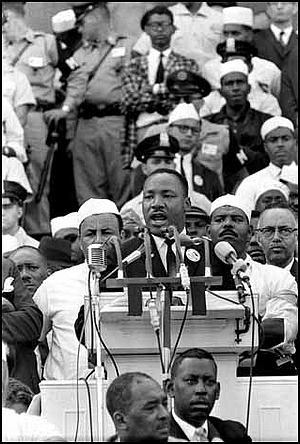
I Have A Dream


While out this morning, on a number of mundane missions at Thompson Plaza (modifying a GIRO payment request, buying lotus root and softbone for soup, the kid's lunch and carbohydate rich canned drinks) I was enjoying the marvel that is my iPod.

In the morning, the family had been discussing the Burmese situation over breakfast.

Now, the shuffle feature brought up Martin Luther King Jr's "I Have a Dream Speech". This has to be the most powerful, moving speech I have ever had the pleasure of listening to. And so much of the message seemed relevant to what was happening in Burma.

The speech was delivered in 1963.
That was the year that Singapore, Malaya, Sabah and Sarawak gained independence, forming the federation of Malaysia on 16th September. This was the root cause of the Konfrantasi between Malaysia and Indonesia under Sukarno. And the still unresolved conflict between Malaysia and the Philippine government over the ownership of Sabah.
General Ne Win had taken power in Myanmar the year before, and must have been busy putting in place his Burmese Way to Socialism, a part of which was the journey inward, towards isolationism.
In Vietnam, Diem was removed (and executed) as leader of South Vietnam on Nov2, in an operation that had CIA involvement in it (ref: Wikipedia). Three weeks later, on Nov 22, JFK met his end in the Dallas Motorcade. (1963 was also the fateful year of the Cuban Missile Crisis)

Wow. A lot did happen in 1963. On a lighter note, 1963 was when Dr Strange, Iron Man, the X-Men, Nick Fury, and the Avengers were launched as a second wave, all the work of Stan Lee, Jack Kirby, Steve Ditko and Larry Lieber. (The first wave was the Fantastic Four, Spiderman, Namor and Thor)

Anyway, back to the "I Have a Dream" speech.
To get video, audio and the text of the speech, this is a good site:
http://www.americanrhetoric.com/speeches/mlkihaveadream.htm
Positively brilliant and awesome speech. It still brings on the goosebumps, even after hearing it umpteen times.
But there is something that I must say to my people, who stand on the warm threshold which leads into the palace of justice: In the process of gaining our rightful place, we must not be guilty of wrongful deeds. Let us not seek to satisfy our thirst for freedom by drinking from the cup of bitterness and hatred. We must forever conduct our struggle on the high plane of dignity and discipline. We must not allow our creative protest to degenerate into physical violence. Again and again, we must rise to the majestic heights of meeting physical force with soul force.
I first heard the speech being delivered by the MAN himself, on an episode of the Wonder Years. The hero was in school, watching a broadcast of the speech on Black&White TV. It was just a small snippet. But big enough to have me searching in those days before the internet got so large and all encompassing, for the text of the speech. I finally bought a book in Seattle in the late 80's (during one of my business travel trips to Boeing while with SIA), a thick book containing what were supposedly the world's greatest speeches - specifically for this speech.

I find it amazing that I have an American sitcom to thank for exposing me to what to me is the greatest speech ever delivered. Bar none.

Monk led protests in Myanmar

This was the big news of the week. Potent ingredients: A group of young monks, well organised, the leaders hidden, communication channels in place, a population inflamed from a botched fuel price increase. One wonders how long the young monks have been preparing, waiting for the right moment (perhaps from as long ago as 1988). Was it their intention to draw the Military Government into committing acts of violence against their peaceful but very visible protesting monks, in order to trigger a turning point in the will of the Burmese people to rise up and in process trigger off the fracturing of stress lines that already exist in the military leadership? Was this bait to draw out the uncapturable beast into the open? The chess piece placed innocently in harms way, apparently unprotected?

News reports keep making reference to the large numbers killed (the Straits Times puts it at 3000) in the last major uprising in 1988, (by which time I had already been at my first job for 3 years, and 1 year prior to my joining hp). It's interesting that Wikipedia notes that the trigger for the student demonstrations was another military junta economic policy - the raising of the price of rice, and the withdrawing of Burmese local currency notes.

What is different now, in a very significant way, is the ability of the young Burmese to capture movies and audio of the action in the streets on their mobile phones. Then, in nearby internet cafes, they would send the recorded snippets of history on to Burmese living overseas (see AFP story), who would in turn post them on blogs and send them to news sites. The risks for this new generation of internet empowered citizen journalists are high. Today's newspapers are reporting that the Generals have cut off Internet access to prevent more leakage of content they don't want the world to see.

The internet is clearly making it harder for oppressive regimes to do their dirty work and keep it hidden from the outside world. Just as the internet is bringing information to those being oppressed - information that changes minds and attitudes, and brings about new thinking that brings about new societies and hopefully gender equality, racial equality and the ever growing income gap.

It's interesting to see ASEAN's response as well. This is not the ASEAN of earlier days. This ASEAN is more aware of the eyes of the world, the importance of it's credibility and one willing to raise it's voice to those in it's own fold. I was happy to see PM Lee and Foreign Minister Yeo calling for restraint, and a move to dialog to resolve the ugly buildup of tension. The phrasing of the messages seemed to suggest pain on the part of the messenger, which added to the heartfelt tone of "I really don't want to say this to you in public, but the repercussions are so serious that it just has to be done".

While reading up about the events in Yangon, I came across this website:
http://www.altsean.org/
On it's front page, there's an interesting poll that suggests that 33% of visitors to this site believe that the confrontation will end with an internal coup within the military junta.
Another interesting piece (I forget the source) talks about how China has all but economically colonized Burma, and compares the Burmese situation with that of Tibet.
The site, Burmanet.org, collects coverage of Burma by the international media.

I remember reading a newspaper article a long time ago, about Dr Goh Keng Swee, which mentioned that the early Singapore government saw Burma as an advanced nation with the brightest prospects of all of South East Asia.

In today's Straits Times, there's an article by David Steinberg, a Georgetown University professor who is currently visiting with the ISS. A quote from his article:
The tragedy of the state, once considered a half-century ago to be potentially the most developed and progressive in the region, is apparent.
It should have been the beacon for development in South-east Asia because of it's natural resources, under-population and higher education standards, together with a functioning, if somewhat creaky, parliamentary system.
Indeed, with the end of the Japanese Occupation, as the colonial masters whimpered their way back to their former colonies, Burma and it's potential leadership under Aung San seemed ready to leap rapidly into the club of independent nations. Backed by it's economic links with Britain and it's rich natural resources, Burma could not help but become wealthy.

How differently things have turned out.

Sunday, September 23, 2007

From the Past:: The raising of senior civil servant and minister salaries

Viewing the YouTube videos in the previous post resulted in my stumbling upon a Sylvia Lim video from the debate on the issue of Ministerial Salary increases back in March this year.

At that time, I had written a letter to the Straits Times Forum that was not published. Here is the text:

Civil Service and Ministerial Salary Increases

Dear Editor.
I refer to your Saturday Insight feature on solving the problem of the loss of civil service talent through increasing salaries, published in the 24th March Straits Times.

I completely agree on the need for capable, honest people to helm positions at all levels of our Civil Service, and that resignations of key talent constitutes a problem for our country.

The focus on salaries, however, sounds like a focus on the symptoms of an illness, rather than the root causes.

Consider a community which noted a trend of increasing levels of serious illness among it's members. "More hospital beds!", they cry. "And we need more doctors and nurses and medicines." Being a wealthy community, paying for these additional hospital beds and medical staff and supplies did not prove to be a problem. Intense discussions were then held on how many additional hospital beds and medical staff was the right number, and in what timeframe they were needed. Unfortunately, few thought to ask why the community was falling ill. Was there pollution of food and water supplies? Insufficient exercise? Overwork? Mental Stress? A new epidemic emerging? The community was more interested in providing facilities for the ill, then in understand and preventing illness in the first place.

Take now the analogy of national defence. Do we merely talk of increasing defence budgets, to buy larger quantities of ever more destructive weaponry? It's to the credit of Singapore's leaders that they speak instead of Total Defence. A holistic view that addresses multiple areas in which the Nation's ability to withstand attack may be sorely wanting.

If good men and women are unwilling to continue working in the civil service, what are the root causes? To what extent do each of these root causes contribute to their desire to leave the civil service for the private sector?

I would like to have seen your Insight feature report on interviews with talented civil servants who have left for the public sector and ask them about their motivations for leaving. Also valuable would be interviews with Head Hunters and the Human Resource managers in the private firms that are drawing away our civil service star performers. Let's see all sides of this important issue, and apply the concept of Total Defence to retaining talent in the civil service.

Saturday, September 22, 2007

Parlimentary Debate on Proposed CPF Changes this week

The most interesting topic in the Straits Times this week was on the proposed CPF changes - raising of the age at which one could draw down one's CPF savings (less the minimum sum) and the proposed annuity scheme. (The second was in the emergence of protests against the Burmese Military Government by Monks)

This brought out from PAP backbenchers some surprising questions about the whole basis for the existence of the CPF and views about how well meaning policies had contributed to the issues that have prompted Minister Ng to propose the CPF changes.

Certainly, population trends, housing costs and GLC monopolies (and near monopolies) can be argued to be contributing factors. But at the heart of the issue is a simple financial question:

Why is it that after so many years of forced savings of a large percentage of one's salary (33% from employee and employer contributions), so many are left with not even enough to meet the minimum sum level when they reach the age where they can draw upon their CPF?

As for any investment, the two key factors that determine what final amount a CPF member can count on are how much gets saved and the rate of return. The % of a worker's salary that goes into CPF is fixed, dependent on his salary, and constitutes a good 33% of his total salary! The rate of return is fixed, and at 2.5% for the OA and 4% for SA, seems on the low side compared to what the major insurance companies are offering as likely rates of return of between 5-8% over the long term for investment linked policies.

Of course, the latter is not guaranteed, but as NMP Siew mentioned in his very well prepared speech, CPF savings may be considered to be not guaranteed as well. Watch Siew Kum Hong's speech in 2 part on YouTube. It'll be time well spent:

NMP Siew Kum Hong Part 1 and Part 2

Such a difference in interest rates, compounded, over a long period like 30 years can make a huge difference.

Sylvia Lim of the WP gave a good speech as well. She made a case for delaying the raising of the draw down age till legislation on employment for the elderly is fully thought through and implemented. Here are Parts 1 and 2.

If watching these videos has increased your appetite for more opinions, I suggest this article from the onlinecitizen.

Monday, September 10, 2007

Ten Things Google Has Found To Be True

Was poking around google.com, looking for a copy of their latest annual report, driven by curiousity about the way it would be presented graphically, visually. I didn't find it. (the closest I could find was a plain text filing with the SEC - not even typographically inspiring!)

There was some good fortune, however.

I chanced upon an article under their philosophy section, titled "Ten Things Google Has Found To Be True".

Click on the article name above - it's linked to the page - to read the details. The 10 things are:

1. Focus on the user and all else will follow
2. It's best to do one thing really, really well.
3. Fast is better than slow
4. Democracy on the web works
5. You don't need to be at your desk to need an answer
6. You can make money without doing evil
7. There's always more information out there
8. The need for information crosses all borders
9. You can be serious without a suit
10. Great just isn't good enough

As I read through, I couldn't help but think of the distinction between information and knowledge. Between what we KNOW and what we know. Between words that merely adorn, and those that inspire and change lives and the world.

What if we could give more data, more information to every living being on earth? Would the world become a better place? Would human relationships improve? Would cruelty disappear? Would wisdom become the norm?

Sunday, September 09, 2007

Kill Bill Notes

Kill Bill has to be the ultimate tribute movie. Watching the film brought me back to the movies of the 70s. Kung Fu, Gangster & Western film memories came flooding back.
I could write lots of raves about Tarantino's Kill Bill. (Wikipedia entry here: http://en.wikipedia.org/wiki/Kill_Bill)

But just a few notes to capture for now:

When Beatrice finds the "godfather" figure in what seems like isolated part of a latin american country, to ask him where Bill is hiding, there is a book on the table titled "The Carrucan's of Kurrajong" by Jasmine Yuen. I've searched all over Amazon for this book. It does not exist.

Hattori Hanzo - I love this character. Saw replica of the bride's Hanzo sword in a shop in Suntec, near the Cinemas, that sells replicas of weapons from popular/cult movies. Had the chance to unsheath it and swing it around. The replica feels wonderful in one's hand. Imagine how wonderful a genuine Hanzo sword would feel.

The Five Point Palm exploding heart technique - again, such wonderful references to Tarantino's inspiration for the film. It's a tongue twister, but so worth memorizing. When Bill first tells Beatrice about the story behind this technique, during the campfire flashback sequence, one knows with certainty that this technique will be the the way in which Bill meets his end. And to stress the tribute, there is a very shaw brothersy music that accompanies the climatic fight scene where the technique is put to use.

The room in which Bill and the little girl stay is Room 101.
This text is from Wikipedia:
http://en.wikipedia.org/wiki/Room_101

Room 101 is a place introduced in the novel Nineteen Eighty-Four by George Orwell.
"You asked me once, what was in Room 101. I told you that you knew the answer already. Everyone knows it. The thing that is in Room 101 is the worst thing in the world." said O'Brien
Room 101 is a torture chamber in the Ministry of Love in which a prisoner is subjected to his or her own worst nightmare.


Thinking of Room 101 makes me think of .......... Milo and his cupboard of anxieties, Calvin and his monsters under the bed.
Which in turn makes me think of the scene where Beatrice is in a hotel room, and has just seen the positive result on her pregnancy test. Then the chinese assassin comes in, and it's really, really tense for a while. The pregnancy test stick changes hands, and the assassin backs off.
Brillaint!


Monday, September 03, 2007

Strange and Really Bad Films

If you have a few minutes to spare, and wouldn't mind a bit of a laugh, visit this page, on 5mtl.com,
http://5mtl.com/ct/international1.html

It lists many films, all non-US (=hollywood), with b-grade corny plots and questionable artistic value. A highly entertaining read, but I wonder if the films would be worth the time to watch.

Monday, April 10, 2006

Podcast & Blogging election ban

I sent this to the Straits Times Forum on the night of 5th April 2006. This letter did not get published in the Straits Times newspaper and online forum pages - which is OK, as it's the editors' right to print what they please. For my own satisfaction, I'm posting it here, for friends to read.

Readers of the Straits Times are often treated to reports of well deserved accolades and global recognition for the high quality of education in Singapore. We have also read of how the Singapore education system has undergone massive changes and received huge investments to create IT literate, critical-thinking, creative citizens well equipped to thrive in an increasingly flattened world.

So it comes as a surprise that Singaporeans, products of our superior education system, are needing to be protected from "a free-for-all Internet environment, where there are no rules," where "political debate could easily degenerate into an unhealthy, unreliable and dangerous discourse, flush with rumors and distortions to mislead and confuse the public." (Paraphrased quote reported in Reuters - see link under References section)

How well the future of our society turns out is a function of the quality of the decisions each citizen makes. Making good decisions requires not just critical, analytical thought processes, but also good access to information. In one of our most important decisions, the selection of members of parliment, we need all the information we can get. A wider range and coverage of viewpoints may allow a few Singaporeans to be fooled by opportunists and charlatans, but it will more than compensate by better spotlighting the true and sincere talents who present themselves for selection as representatives of the people.

There is no place for a law to stop citizens from posting recordings and photographs of election rallies in personal blogs.

References:

A Straits Times article can be found at this link, which at this time, 2pm on Sunday 9 April 2006 is still available for free access. Once this article goes into the archives, one will need to pay SPH for access to the article:

The Straits Times - Political podcasts, videocasts not allowed during election - Tue Apr 4, 2006

The quotation from Dr Balaji that I paraphrased above is from this Reuters report:

Reuters.com - Singapore warns bloggers against political postings - Mon Apr 3, 2006

Tuesday, January 31, 2006

Enjoying Liberty Meadows

"Schecky the Monkey King threw caution to the wind. The trail of the flesh eating white apes of the Lost City was clear to his jungle-bred senses. He knew that the apes had kidnapped Cindy and that she would soon be devoured as part of their twisted ritual sacrifice."

So begins another episode of Schecky the Monkey King, with a look reminiscent of the Russ Manning Tarzan strips we used to read in the Sunday papers. By the way, I have a few scans of the last of the Russ Manning Tarzan strips, before he handed the strip over to Mike Grell. If you're interested, write me.

Schkey and Mighty Shmoe Pong are part of the reading diet of the bizarre characters in Frank Cho's liberty meadows. The best way to tell if you'll enjoy Liberty Meadows is to score yourself against the following test:

1. Have you ever been a fan of Edgar Rice Burrogh's Tarzan and John Carter, Warlord of Mars novels?
2. Have you ever been a fan of things Star Wars (the original trilogy, in particular)
3. Do you get a kick out of Dinosaurs and Giant Apes?
4. Do you enjoy clean line art? Black & White as opposed to monochrome graduated patches or airbrushed colors?
5. Do you enjoy touches of insanity in your reading matter?
6. Ever associated yourself with geekdom, and are able to sympthatize with the trials and tribulations of geeks?
7. Ever fantasized about or fell in lust/love with a comic book super heroine?

The more "yes" answers you have, the more you'll enjoy Liberty Meadows. I love Bloom County and Calvin & Hobbes for many of the same reasons - all these strips have very strongly defined characters who can carry off the gag by simply being present. But there's much more of a fanboy aspect to Liberty Meadows.

There's a nice tie-in here to an earlier posting about Peter Jackson's King Kong - Mighty Shmoe Pong is a direct spoof of Kong - dinosaur fights and all.

Frank Cho's Liberty Meadows Internet Sanctuary website is linked here.

Sunday, January 15, 2006

Mr Muo's Travelling Couch - the stuff of dreams

I picked up this book by Dai Sijie at Takashimaya during the plant shutdown week (the several days between Christmas and New Year's day 2005). This would be the first non-fiction book that I would read to the end all year. The first few pages went by easily enough on the first night's read. I resumed the second day, a dreary rainy evening, which followed a day in which non-stop rains pelted the already sodden earth.

Evening turned into night, then into early morning and I, unable to put the book down, completed it at 3 in the morning, completely wide awake. Quite a trip.

While reading, I had been trying to make sense of the book, and in parts, it actually did make sense. But with the story all done, and the newly won luxury to step back and see it as a whole, I realised that it was not unlike many dreams I have gotten caught up in, over lo these many nights of slumber.

During the time of dreaming, the dream events seem so completely logical. So real.

Yet on waking, seen in the harsh light of reality, I discover that the management presentation or the marketing plan I had been formulating in my sleep that seemed so brilliant just minutes before was actually quite unusable in the real world. My profound work degenerating into the silly and nonsensical at the speed of thought.

So perhaps that's what the author tried to do? Construct a novel that read basically like a dream, where once immersed, the logic and the flow of events seem sensible and logical, but on waking, one finds it was a passing of time that did little for the hard, material side of ourselves. Yet perhaps the dream did something for the part of our minds that need the spell of insanity and the parts of the body that need the corresponding nightly immobilization.

You can obtain a good synopsis of the book from Amazon's site, and this spares me the task of reproducing it here.

Suffice to say, the main character, Mr Muo, is an odd specimen, believing he can help others with their lives through explaining their dreams to them using the tools and ideas of Freud and Lacan. He takes to the road, a pychoanalyst in rural china, in search of the one thing he needs to help free his two imprisoned girlfriends from the clutches of a corrupt official - a virgin maiden.

Living mostly in his world of academic knowledge, he is stunted and awkward and lacking in healthy relationship experience. Yet be believes himself superior to the unlearned masses. He is forced by circumstances to discover himself through his interviews with his "customers" - an array of peasants, workers and a 50 year old policewoman.

The idea of stories and dreams being tightly related was expounded brilliantly by Neil Gaiman in his Sandman series. But although Gaiman introduced realistic snippets of dreams (an oxymoron, surely) in some of his storylines, there were very few that came across as entire dream episodes.

Reading Mr Muo made me think back to odd dream snippets, that many years after the dreaming, that are still fresh and vivid in my mind. Or so I think. I recall being in a boat gliding through dark caverns, and looking up, glanced at a joke painted on a sign mounted at the entrance to a cave. It was the funniest joke I'd ever come across in my life, and I promised myself that when I awoke, I would recall the joke and publish it. To this day, I can't for the life of me figure out what that joke was. But this I know... it was absolutely hilarious.

There's much more that can be said about dreams. The songs. The dark side. The images. The symbolism. Dreams are fascinating. Why do we dream? Do we need to? Were I truly enlightened, would dreaming still be necessary?

Sunday, January 01, 2006

The Tragic King - from infantile to noble beast

The 3 hours of Peter Jackson's King Kong didn't feel any longer than the typical movie. The film just kept roaring ahead, full of captivating visuals, characters that we've met many times over in different guises, with different names, in different stories....not so much as stereotypes, but as archetypes.

The overriding image I have of the film is that of a creature, at first feared, reviled....later pitied and perhaps a little admired, falling down, down, down to his end in slow motion, having fought for and beheld, for too short a time, his.....precious. Now where have we seen this before?

The other image that comes very much to mind is from the first time I beheld the wallpaper downloads from the movie site. The closeup of Kong's face, showing the scar on the right side of his face. This was a creature that had not led a peaceful life. Skeletons near the top of the mountain ledge from which the sunset view gives Ann an excuse to say and gesture "beautiful" suggest there were others like Kong. It would have been wonderful to discover if Kong was the last of his kind, or if there were others still roaming the island.

There is also the parallel of the sheer cliffs and canyons of Skull island and the buildings in the city of New York. This is reminiscent of a comic series Steve Englehart did many years ago for Marvel called "Coyote" in which the main character, a young hothead with american indian shamanic powers, was able to shift to an alternate dimension in which he would "see" man-made cities as being like the cliffs, canyons and plains of the desert.

It's easy to watch the giant fanged bats swooping around Kong, distracting him as Ann and Jack sought their escape, and see them as the bi-planes with their machine guns and teeth of steel swooping around the beast as he made his last stand on the summit of the empire state building. In the latter case, instead of fleeing Kong, Ann persists in making her way to where Kong is, away from the safety he tries to win for her, believing she can protect him.

Up till this time, it's been Ann that needed protection from Kong. She starts the film as a person with hopes, but also a person who's lost. She needs a protector. Her life is about make believe - in the theatre, reading scripts in the hopes of getting parts in plays and movies. Just like Jimmy, the boy on the ship. Found as a baby on the ship, he was lost too, and had the Black sailor, Hayes as his protector. He lived in his own little world too - that of the ship. And to get beyond that, he reads....like Ann, a piece of fiction. There is a scene on the boat where Ann and Jimmy are dancing on the deck - and you can see then that they are in the same situation. Just as Jimmy's protector, Hayes, dies in the film, so does Ann's protector, Kong. Which reminds you of the words of the old man when the actors find the theatre has been closed down and they won't get the wages they were counting on... he said something like this to Ann, "Everyone whom you've ever depended on has let you down".

I enjoyed the absence of proper characters, apart from Kong and Ann Darrow. This was an epic film, and epic films, like fairy tales, are full of archetypes. Carl Denham, the man who destroys and debases everything that means most to him. Captain Englehorn, the dutch sea captain who knows more and is more than he seems, deep and dark and mysterious as the oceans he traverses. Jimmy, the boy impatient to become a man, and Hayes, the man who is like a father to him. Choy, the chinese crewman and Lumpy, the cook who loves him.